
Beyond Champagne and Leather Seats: What Actually Defines a Private Jet Experience
Beyond Champagne and Leather Seats: What Actually Defines a Private Jet Experience
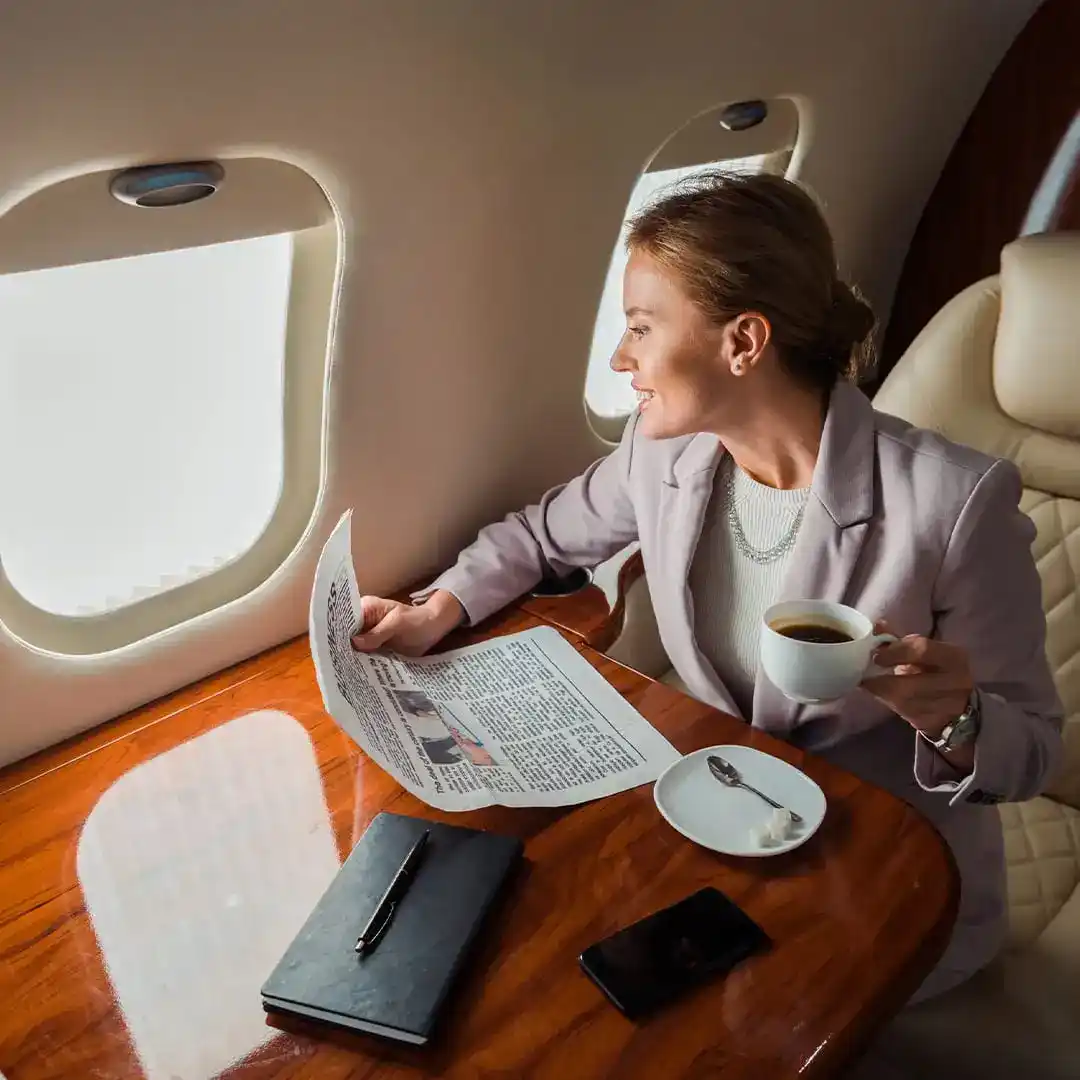
Private flying is often reduced to a familiar collection of images: polished cabins, soft leather seats, thoughtfully arranged drinks, quiet lounges, and elegant meals presented somewhere above the clouds. Those details certainly influence perception, but they explain surprisingly little about what actually defines the experience.
The more meaningful differences often happen outside the photograph.
Scheduling flexibility, airport choice, ground coordination, cabin suitability, privacy, baggage planning, passenger requirements, and communication can shape a journey far more than decorative details. Even the highly attractive cabin can become inconvenient if the aircraft does not suit the mission.
Understanding private flying therefore requires looking beyond what is immediately visible.
The Experience Starts Before Boarding
A private flight does not begin when someone steps onto the aircraft.
It begins during planning.
Passengers may need to determine departure timing, destination requirements, passenger numbers, baggage quantities, ground transportation, catering preferences, and other practical details.
How smoothly these pieces come together influences the entire journey.
Clear communication matters particularly because private flights can involve requirements that vary considerably between journeys. A trip with two passengers carrying small bags presents a very different planning challenge from a larger group traveling with substantial luggage.
Good planning reduces surprises.
That may not photograph particularly well, but it is one of the highly important parts of the experience.
Flexibility Is Often More Valuable Than Decoration
One of the defining characteristics of private flying is the ability to build a journey around passenger requirements rather than fitting every passenger into the same standardized schedule.
Departure times can often be planned around the broader itinerary.
This can matter more than cabin decoration.
A beautifully appointed aircraft departing at an inconvenient hour may provide less practical value than a simpler aircraft operating at a time that fits naturally around meetings, events, onward transportation, or personal plans.
Timing also influences the cabin experience itself.
A morning flight may become a productive working period. A late departure may be structured around rest. A midday journey could function as a transition between activities.
The value of flexibility comes from using time deliberately.
Airport Choice Changes the Ground Experience
The nearest major airport is not always the highly practical departure or arrival point for a private flight.
Depending on operational requirements and aircraft capability, different airports may provide different levels of convenience.
This can influence driving time, ground transportation, passenger processing, and the overall length of the journey.
The important measurement is therefore not simply flight duration.
Door-to-door travel time provides a more complete picture.
Saving time in the air means relatively little if passengers spend unnecessary hours reaching or leaving the airport. Conversely, a slightly different flight plan may make sense when it simplifies the ground portion of the journey.
Private flying becomes more useful when aviation and ground transportation are considered as one continuous itinerary.
Aircraft Suitability Matters More Than Appearance
A larger aircraft is not automatically a better aircraft.
Neither is the newest-looking cabin necessarily the highly appropriate choice.
The aircraft needs to fit the journey.
Passenger count, route length, baggage, airport characteristics, desired cabin activities, and operational requirements all influence suitability.
For a short journey with a small group, additional cabin space may provide little practical advantage. On a longer flight, however, room to move, work, eat, or rest can become significantly more important.
Baggage capacity deserves particular attention.
An aircraft may accommodate the passenger group while providing limited room for the luggage they intend to bring. Unusual items can create additional considerations.
The right aircraft is therefore the one whose capabilities align with the actual trip.
Privacy Is More Than Being Alone
Privacy is frequently associated with private flying, but it has several dimensions.
There is physical privacy, created by traveling with a selected passenger group. There is also conversational privacy, schedule privacy, and the ability to use the cabin without sharing the environment with unrelated travelers.
For some passengers, this creates an opportunity to work or hold conversations during the journey.
For others, privacy simply means being able to rest without navigating a crowded shared cabin.
However, privacy should not be confused with the absence of procedures.
Passenger identification, documentation, safety requirements, and other applicable processes remain part of aviation. Private flying changes the environment and passenger experience, but it does not make operational responsibilities disappear.
Cabin Comfort Depends on the Mission
Leather seats alone reveal very little about how comfortable a flight will actually be.
Seat design, cabin height, noise, lighting, temperature, layout, window placement, and flight duration all influence comfort.
The mission changes which features matter more.
On a short daytime flight, passengers might prioritize convenient seating and easy conversation. For a longer journey, the ability to rest may become much more important.
Someone intending to work could maintain table space, power access, lighting, and seating posture.
This is why cabin evaluation should begin with a simple question:
What will passengers actually be doing during the flight?
Once that is clear, useful features become easier to identify.
Service Works Ideally When It Feels Coordinated
Visible hospitality is only one part of onboard service.
The less visible element is coordination.
Meal timing, cabin preparation, passenger preferences, baggage handling, and communication all contribute to whether the journey feels organized.
Effective service does not necessarily mean constantly adding more.
Sometimes it means removing unnecessary interruptions.
A passenger trying to sleep may value quiet more than repeated attention. Someone working may prefer meals at a specific point in the journey. A family group may have entirely different priorities.
Service becomes meaningful when it responds to the purpose of the trip rather than following an identical routine for every passenger.
Catering Is Really About Timing
Food is another feature frequently associated with private cabins, yet presentation is only part of the equation.
Timing can matter just as much.
A meal served during a short flight can consume much of the available cabin time. On an overnight journey, passengers may prefer to eat before departure so they can rest sooner.
Morning departures create different requirements again.
Dietary needs, portion sizes, storage limitations, flight duration, and the number of passengers can all affect catering decisions.
Rather than asking only what food is available, passengers can consider when they actually want to eat and how that decision fits into the journey.
This turns catering from a decorative feature into part of the itinerary.
Ground Coordination Can Make or Break the Journey
Landing is not the end of travel.
Passengers still need to reach wherever they are actually going.
Ground transportation therefore plays an important role in the overall experience.
If a vehicle is poorly timed, unclear about the pickup point, or unsuitable for passengers and baggage, a smooth flight can end with unnecessary waiting.
The same principle applies before departure.
Aircraft scheduling and ground transportation should ideally work together so passengers are not building large waiting periods into a journey intended to improve scheduling efficiency.
The ideal itinerary is not simply a good flight.
It is a well-connected chain of movements from the starting point to the final destination.
Reliability Is Less Glamorous but More Important
Some of the highly valuable aspects of private flying are nearly invisible when everything works properly.
Communication is one example.
Passengers need clear information about departure arrangements, documentation, baggage limitations, schedule updates, and other relevant requirements.
Weather, procedural considerations, airport conditions, and operational factors can sometimes affect aviation schedules. When circumstances change, clear communication becomes far more important than decorative cabin features.
A polished table setting cannot solve an unclear itinerary.
Dependable coordination often creates more confidence than anything passengers can photograph inside the aircraft.
The Ideal Experience Is Usually the Highly Appropriate One
The idea of a private jet experience can easily become tangled in symbols of extravagance.
But those symbols are not the experience itself.
A successful journey is one where the aircraft suits the route, departure timing supports the passenger's schedule, baggage requirements have been considered, the cabin fits the intended activities, and ground arrangements connect smoothly with the flight.
Sometimes that may involve an elaborate meal and a spacious cabin.
Sometimes it may involve a relatively simple flight designed primarily to move a small group efficiently between two points.
Neither is inherently more authentic.
Private flying is defined less by how many impressive features can be added and more by how precisely the journey can be shaped around its actual purpose.
Champagne can be poured. Leather can be stitched. Interiors can be photographed beautifully.
But when the cabin door closes, the qualities that matter more are usually quieter: suitability, timing, coordination, privacy, communication, and comfort.
Those are the elements that turn an aircraft journey into an actually considered private flying experience.